Saturday, September 26, 2009

Life since June

So I was inspired to write a quick update and share some pictures from random stuff I’ve done since June.  I’m writing this before I actually sit down on a real computer and hope to share about 20 photos, which I’ve resized.  

Photo 1.  I got to school early one day during my two week camp after the end of the spring semester.  Some students looked at my guitar longingly so I let them mess around with it.


Photo 2.  The majority of my camp consisted of team building activities and games.  I’m pictured here with Maxim and Maxim.  The Maxim on the left is screaming BLIN, which translates literally as PANCAKE but colloquially means CRAP!
 
Photo 3.  An old Soviet bus arrived at my school unexpectedly, offering to whisk us away to our local milk factory.  The field trip included a climb up the most precarious ladder I’ve ever seen, flaming milk experiments, and by far the worst smell I’ve encountered yet in Ukraine.  I did find out that a by-product of some of the cheeses they make is mixed with asphalt to make roads.  With that said, I need not describe the roads here to you.  Not only did I want to stop drinking milk after this trip, I thought it should be my duty to euthanize cows to save them from such a fate.
 
Photo 4. Brinza cheese, which is somewhat sour/bitter but goes well with bread.
 
Photo 5.  After the hour long tour on a ninety five degree day, the workers at the milk factory gave each student a heaping cup of sour cream!  I received an extremely dirty look after politely declining.  I was also yelled at by the manager for taking this picture. 
 
Photo 6.  This is me on the top of the factory with the “other side” of Belovodsk behind me.  You can see in the background how the land gradually rises.  The big hill in my town separates my side from this part.
 
Photo 7.  This is a view of mountains and the Danube river from the Bratislava Castle in Slovakia.  Unfortunately the castle was under construction so the pictures of the structure itself are not very good.
 
Photo 8.  This is the Danube River which runs through Bratislava, the capital of Slovakia, and connects it with Vienna, Austria. 
 
Photo 9. The rooftops of Bratislava and the architecture in general greatly differ from what I’m accustomed to seeing in Eastern Ukraine and even Kyiv for that matter.  After Peace Corps, I will be able to say that I lived in Europe for two years but it doesn’t really it.
 
Photo 10. This is the old town square in Prague, the capital of the Czech Republic.  It is one of the biggest tourist cities in Central Europe and is known for being relatively unscathed during WWII (unlike London, Dresden or dozens of other cities).


Photo 11. Same as above.  Prague is great.  It is the home of art nouveau, Franz Kafka, a cathedral with a shriveled arm, the world’s only cubist café and much more.
 
Photo 12.  This is the famous St. Vitus Cathedral inside Prague Castle.  Even after all the photos and videos I’ve seen, the hype did not kill the experience.
 
Photo13.  The famous Prague Clock.  Next to the clock you can see small figures representing vanity, greed, pagan invasion, and death.  Every hour, the clock rings and the 12 apostles come through and show through a small window.  The times listed include the hours of the day, the zodiac, the times of sunrise and sunset, and the phases of the moon. Legend has the clock maker’s eyes were removed after he finished so he couldn’t replicate his work for anyone else.
 
Photo 14. Mural at St. Vitus Cathedral.
 
Photo 15. Half of the old city hall in Prague's center, destroyed by the bombs of WWII.
 
Photo 16.  The hostel’s kitchen in Prague.  We stayed at Sir Toby’s which was the best Hostel I’ve been to, equipped with a pub, lounge and outdoor area.
 
Photo 17.  One of the many many many Cathedrals in Vienna, Austria.
 
Photo 18.  This is the Summer Palace for the Hapsburgs, the ruling empire of Austria-Hungary up until the end of WWI.
 
Photo 19. Same as above.
 
Photo 20.  This is the view from the hostel window.  We stayed at Wombat’s which was like a college dorm.
 
Project 21.  Camp iKnow, the camp implemented by the Environmental Working Group, expanded from one camp last year in Ternopil, to three camps this year.  We had seven volunteers and fifteen students from Donestk, Lugansk, Mikolayev, Lviv, and Zaporizha.  Kids are taking a break from the environmental lessons and activities to make friendship bracelets.
 
Project 22.  With 90 degree days, we made daily trips to the local swimming hole.
 
Project 23.  A fun camp game with singing and hand slapping.  Of course an American won.


Project 24.  Students making fish out of bottles, Alex’s trash art session.
 
Project 25.  After spraining my ankle, I was not allowed to stand or walk by my PC medical officer.  I had to teach a leadership lesson and decided to just use my body as a blackboard.


Sunday, June 21, 2009

My Dad's Visit to Ukraine

May 28th

This is my first blog in quite some time and I’m glad I have significant events to discuss regarding my living abroad in the Borderland – Ukraine. On May 28th, 2009, my father came to visit my home of the past 21 months in Eastern Ukraine. We’ve discussed this possibility for some time and before I joined the Peace Corps my dad said he would be certain to visit wherever my country of service would be, whether Morocco, Kazakhstan, or Fiji. When I found out I would be serving in Ukraine, one of my dad’s initial reactions was “Well, I’m excited too because until now I never would have had a reason to go there, so it is a country I wouldn’t have seen otherwise.”

I was rather nervous about him coming, since Ukraine, like much of Eastern Europe, is not as equipped to suit tourists as Western countries. My dad would have to make his own way to my oblast center Lugansk by himself as I couldn’t take time off to meet him in Kyiv due to my work. However, the excitement of knowing someone who supported me from my early curiosity toward Peace Corps would soon see where I work and live. I think it is very important to have an outsider’s perspective as I may be desensitized or somewhat biased regarding Ukraine. I really couldn’t wait to hear my dad’s interpretations and impressions of this country.

Arrival

My dad flew from Chicago to Zurich, Switzerland, then to Kyiv, Ukraine, then to Lugansk, Ukraine. He spent some time in Germany and Switzerland a few years back and the layover was too short for the time there to be memorable. However, the flight to Lugansk was five hours after he arrived to Kyiv and opportunities for killing time in Boryspil Airport leaves much to be desired.

I barely slept the night before I went to pick him up. I had to go to Lugansk by bus and hang out at my friend Seth’s apartment who left me his key. It was without a doubt the longest day of my service, waiting around until ten o’clock at night. I had to take a taxi out to the airport which was the size of Gary’s, running only five or six flights daily. I wasn’t sure where to wait but there were others meeting family so I shadowed them. It was a strange feeling to see all the upper class Ukrainians come through the gate, most people travel by train here as it is unbelievably cheap. Then, my dad came through, smiling, and the first thing I noticed was his Harley Davidson shirt. His trip to Lugansk passed free of hindrance, despite it being extremely long and physically tiring. We had to stay at Seth’s apartment due to his late arrival: my town is two hours from Lugansk and buses do not run late.

He refused to take trains to and from Kyiv in order to save time, but I introduce my dad to the Ukrainian public transportation system through minibuses, taxis, and eventually the subway in Kyiv. Riding the bus to my town the next day, my dad had a glimpse of what I have to deal with as the bus was crammed, hot, and not one window was open. I have more than grown accustomed to this form of travel.


We arrived at my apartment, which is a typical Ukrainian apartment with a small bathroom, small kitchen, and one room which acts as a living room and bedroom. Despite its relative tackiness and gaudy décor, including burnt orange flowery carpet, forestry wallpaper, imitation Persian rugs on the walls, and a metal plaque with a naked woman, my dad was relatively impressed with my living quarters. Considering what volunteers in other Peace Corps countries have to go through, my apartment may be laughable in America but here I am proud to live here. He soon realized my idiosyncrasies which I displayed in America were still intact here, as I am rather obsessive about cleaning, organizing and I still working in the kitchen!


Time in Belovodsk

One surprise for my dad was I must walk everywhere in my town as it is too small for buses or taxis yet large enough to tire you if you walk from one side of town to the other. Another early observation was the amount of monuments and statues in my town. Walking from the bus station to my apartment we crossed a giant Soviet WWII memorial, and later he saw the Chernobyl memorial, Bolshevik Revolution monument, Lenin statue, and another WWII monument. Perhaps we have as many monuments in America, but we are never out of our cars long enough to notice them.

My dad had several opportunities to see the emphasis put on student performances and presentations in Ukraine. Our first day in town, a two hour concert at the House of Culture exhibited traditional Ukrainian music and dance, as well as modern song dance routines. I have lost count of how many of these concerts I’ve seen so the novelty has somewhat expired, but my dad was impressed by the amount of activities available to youth even in my small town.

A few days later, he had another chance to view students’ talents at a different concert at the same place. An organization, Lugari which would best be described as co-ed Boy Scouts put on a concert also consisting of various song and dance repetitions. However, the ultimate display of student talent came in the form of a backyard performance in the yard of my apartment complex. Several children, ages ranging from 4-10 from what I gather, knocked on my door and called us down to watch their performance. Basically, it amounted to hanging a rug on a clothesline for a backdrop/changing area and my father and I, along with some parents, watching an hour long private concert. Herman, one of my site mate Chris’s students, played three different instruments; students sang songs and read poetry in Ukrainian, acted out famous fairy tales, and even a hula-hoop act. It was cute in its awkwardness as the children spoke quietly and continuously forgot to address the “audience,” got distracted by people walking by, and played behind the stage curtain. Most of it was in Ukrainian which meant I was as confused as my dad, but we both felt like we had the chance to witness something special.

Unfortunately, the second day of my day camp at school my counterpart informed me my dad could not participate since he does not have the proper documents from the Ukrainian government allowing him to interact with students. Tuesday and Wednesday he was then forced to stay at my apartment. He subsequently spent his afternoons reading and watching 24. Although my apartment is usually hot in the summer, reaching up to 83 degrees in the living room and as high as 97 degrees in the kitchen if I make the foolish mistake of using the oven, it was rather temperate after my dad refused to endure such heat and bought me a fan. I've learned to live without those little privileges and it has helped me to save a large sum of my Peace Corps money for travel.

We spent the afternoons going for walks, looking at my pictures and videos from my service, and we even watched a few episodes of BBC's Planet Earth, prompting my dad to say WOOOW every three minutes. We spent time with my sitemate, eating smoked cheese, smoked fish, and smoked sausage, drinking Ukrainian beer, and playing cards. On Sunday, we went to visit my host family whom I lived with during my first month in Belovdsk before I found an apartment. My dad was amazed by how self sufficient they are, growing, building, and raising everything themselves. In their yard they have bees for honey, chickens, goats, strawberries, raspberries, greens, and just about every vegetable in season. Yuri, my host dad, showed us his cellar where they store food which included jars of jam, fat, and meat.

We ate a large early dinner together which included borsch, pampushky which are garlic buns, and this great dish consisting of fried potatoes which were then baked and meat. The samagon, bathtub vodka, was pulled out at the first chance and my dad got a chance to see what real homemade liquor was like. He brought presents including decorations for my host mom Valentina, US quarters for Yuri because he collects coins, CDs and a poster for Tonya who loves music, and a Boston Celtics jersey for Dima though he was still at college in Kharkiv. Feeling so blessed, they gave us a giant bottle of cherry compote, cherry preserves, cherry wine, and more food than we were ultimately able to eat.

As if this day wasn't enough, the last evening before we set off together for Kyiv, my neighbors invited us outside for a feast on the picnic table. My dad, Chris and I along with five of my neighbors sat around eating for two hours and talking, each group asking questions of the other, much like dinner with my host family. What is life like in America, was the Soviet Union better, will the economy get worse, what do you like most about your country – these were some sample questions of our discussion. At one point, while outside on the picnic bench alone, a different neighbor approached my father trying to remember as much English as possible, explaining he was a soldier for the Polish military. He then went to his apartment to put on his uniform and then presented my dad with gifts, including an autographed book about my oblast and a military photo.

While he was here, my dad had a different perspective on things. I watched the things he chose to photograph or whatever seemed to catch his eye and it greatly differed from the things that strike me. He assumed Ukraine would be perhaps less developed and was surprised by how clean things were. I found this interesting as often volunteers complain about the amount of trash, but having an "outsider's" perspective, it made me try to look at this country differently, look beyond all my biases I have gained living here. His favorite line throughout the trip, however, was "That's not up to code" commented on either bad wiring or construction and absolutely refused to use a public toilet, which are often squatting toilets.


Kyiv

Saving time, we flew from Lugansk to Kyiv on a Thursday morning at seven o'clock, which was a shock for me. My usual trip by train takes at least 16 hours and the flight was only an hour long. In fact, the flight from Lugansk to Kyiv was shorter than the taxi ride from Kyiv's airport to the hotel. It was great to have a chance, on my Dad's dollar which I am more than grateful for, to see a different side of Kyiv and be a tourist for a short time.

We checked into our Hotel, I believe a four star with something like ten restaurants, car services, and English Speaking staff members and I was dumbstruck. The hotel where I usually stay costs ten dollars a night and electricity and hot water are never a guarantee. My dad took a shower as soon as possible as my apartment doesn’t have hot water and he felt like a new person. He roared 'Man, I haven't showered in eight days' to which I replied 'When's the last time you think I took one?!" We set off for the city, taking the subway to Independence Square, the center of the city and the ritziest part of Kyiv. From there we saw St. Michael's and St. Sofia's cathedrals, taking plenty of pictures and stopping to take in the views as it is greatly different from even the oldest or biggest cities in America.

We decided next to go to the National Chernobyl museum which was an educational and moving site. Equipped with audio headsets in English, we walked around the museum observing tens of thousands of documents, personal items, and pieces of art and photographs of the tragedy. There was almost too much information and at times it was overwhelming.

Feeling rather tired after walking so much and waking up at four, we went back to the hotel and rested until dinner. I tried to find neat memorable places to take my dad for food and the Drum was a must. It is in this scary alleyway and located half underground down a stairwell much like a speakeasy. Of course he made a joke like "I'm not going in there" but ultimately enjoyed the atmosphere as the establishment has room for no more than 20 patrons.

The next morning, I got up at six to meet Bethanie at the train station as she arrived from Crimea. She shared the luxury of staying in such a nice by showering and having a few plates at the buffet breakfast and again we were off to see things in Kyiv. We went to the World War II museum, and coincidentally it was June 6th, the anniversary of D-Day. The facility was three floors yet we had only the strength to explore the first two. Words can't really do these places justice and I will post pictures as soon as I can. Following the museum, we went to the National Art Museum which contained everything from religious artifacts to post-modernism and cubist artworks. Souvenir shopping was done at Andrew's descent, a winding stone street leading up a hill to St. Andrew's cathedral. Along the road are vender's with items and gifts, most of them tacky, to sell to tourists and my dad had a fun time haggling with them as they know enough English to conduct their minor business. We were back and forth top to bottom left to right in Kyiv on the subway and in taxis for two days straight.

The second night in Kyiv and last night of my dad's trip, we made reservations for a restaurant called Porto, which I read about in a guide and thought it would appeal to my dad's tastes. My dad, Bethanie, fellow PCV's Amber and Seth, along with his sister who was visiting, my former Russian language teacher Max and his wife Lena all joined us at this chic restaurant. It specialized in seafood and there were giant ice sheets with whole fish laying out which you could choose, and then select how you wanted it to be cooked. My dad was more than in his element, being a host that is, and more than took care of my friends and me. Max and my dad hit it off, sitting next to each, as Max acted as the main translator and interpreter for the evening. We had more food than I could ever wish to describe, but I will say it was amazing. There were plates of fish on fire, giant salads, octopus tentacles, wine, four or five different kinds of fish and of course desert, and then flaming after dinner liqueurs. Needless to say it was a step up from making tuna sandwiches in the Peace Corps office lounge. My dad was glowing after the dinner and I felt glad the place I chose suited us perfectly. It was the best way to end his trip, hosting others in their own country, meeting my friends here, and of course laughing.

It was an amazing trip and though a lot of this blog is simply a recount of what we did, I have a lot more to say about the impact and impressions it left as well as my Dad's observations. I'll leave that for another time.

I'm off tomorrow on a train and will be spending the next two weeks in Slovakia, Austria and the Czech Republic. Safe travels and talk soon.

Saturday, April 25, 2009

When awareness is combined with sympathy, they always bring tolerance and support.

When awareness is combined with sympathy, they always bring tolerance and support.

Friday, the tenth of May was the second part of my HIV/Awareness campaign relating to my project at my small village site in Eastern Ukraine – a rock concert by and for students. The main focus of the work is giving teachers the tools, facts, and strategies necessary for talking to students about sex, narcotics, and ultimately HIV/AIDS. While planning this work, my counterpart and I organized opportunities which expose students to facts, myths, and statistics regarding the HIV/AIDS epidemic, but doing so through events which attract their attention (see also: the previous blog regarding the school dance).

Unfortunately, Inna, my project counterpart has been out of school for nearly three weeks now, including the week leading up to the rock festival, due to health issues. Inna did an excellent job planning and executing the school dance and similarly planned the rock festival. However, I found out the day before she would not be able to attend so I had to first find out where she left off and then pick up from there. Thankfully, my English teaching counterpart Raisa and my school director Zhanna helped me immensely.

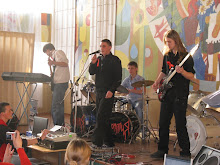
The two hour schedule included four student group performances, Simbioz, Anomalia, Fallen Angels, and Cemetery. In between each performance we hoped to show segments of Queen’s benefit performance for HIV/AIDS awareness in Kharkiv, Ukraine’s second largest city containing the greatest student population. The video included information about the life and death of Freddie Mercury, facts regarding the epidemic, and Queens performance which was watched by nearly 300,000 Ukrainians in Kharkiv’s square.

Around 4:45 on Friday, fifteen minutes before the start of the concert, few students had arrived to our school’s auditorium. I faced the conflict of the first band starting with barely any audience versus the inability to delay the start by more than a few minutes. Additionally, the auditorium was still well lit from increasingly longer days and I wasn’t sure the film would be visible under such conditions.

Ultimately, we started half an hour late which proved inconsequential. I gave the same speech in Russian from the school dance and then introduced my really good friend Brad Luckhardt. Having studied Russian for several years, he gave a much better, more advanced speech. Brad’s speech follows:


Good evening respected guests,

I thank you all for coming to this evening’s meeting. I want to say a big thank you to Mr. Alan (me), his colleagues, and especially his students for all of their efforts. Some of us here know the facts about the AIDS epidemic in Ukraine. An independent estimate by the United Nations says that in 2007 there were around 400,000 HIV positive people living in Ukraine. In that same year the United Nations believes that around 20,000 people died of AIDS in Ukraine. That statistic is even more frightening because it represents real people who live around us; our neighbors, our friends, and our relatives. We should know that in reality all types of people can have HIV and that being HIV positive doesn’t say anything about a person’s personality.

It is my opinion that the most difficult obstacle in our fight against HIV/AIDS is a lack of awareness. What does that mean? What should we know? Without question we should know how HIV is transmitted and in which ways we can protect ourselves.

Moreover, we should know that a HIV positive mother has a good chance of giving birth to a healthy child, given that she knows her own HIV status and that she does everything possible for the child’s health. Additionally, we should know that if people living with HIV learn about their status early enough, they can live a full life with the help of medicine which, by the way, is available free in Ukraine.

Knowing all of this we can live without fear. This is most important because if we live in fear we cannot support one another. When awareness is combined with sympathy, they always bring tolerance and support.

I hope that events such as our concert this evening will be the first step towards a society in which we can live hand in hand, with mutual support, without fear, regardless of our HIV Status. I wish you good health, a pleasant mood, good listening, and all the very best.


Добрый вечер уважаемые гости! Я благодарю вас всех за то, что вы пришли на нашу сегодняшнюю встречу. Я хочу сказать огромное спасибо Mr. Alan, его коллегам, и особенно его ученикам за все их усилия.

Некоторые из нас знают факты об эпидемии СПИДа в Украине. По независимой оценке ООН в 2007ом году на территории Украины проживало около четырёхсот тысяч ВИЧ-инфицированных людей. В этом же году ООН тоже считает, что около двадцати тысяч погибли из-за СПИДа. Такая статистика страшнее потому, что она представляет настоящих людей, которые живут вокруг нас – наши соседи, наши друзья, и наши родственники. Мы должны знать, что в действительности все категории людей могут иметь ВИЧ, также позитивный ВИЧ статус не говорит ничего о личности человека.

По-моему мнению, самая большая трудность в борьбе с явлением ВИЧ/СПИДом недостаток знаний. А что это значит, что мы должны знать? Однозначно мы должны знать, как ВИЧ передаётся и какими способами можно защищать себя, также мы должны знать что ВИЧ-инфицированная мама имеет все шансы родить здорового ребёнка при условии, что она знает свой статус и делает всё возможное для спасения своего ребёнка. К тому же, если инфицирован человек узнаёт свой статус достаточно рано, с помощью лекарства, которое между прочим выдаётся бесплатно в Украине, он может жить полной жизнью. Зная всё это, мы можем жить без страха. Это главное потому, что если мы живем со страхом, мы не можем поддерживать друг друга. Когда знание соседствует с сочувствием, они всегда привносят толерантность и поддержку.

Я надеюсь, что такие мероприятия как наш концерт являются первым шагом к обществу, где все могут жить рука об руку с поддержкой и без страха, невзирая на их статус. Я желаю вам всем крепкого здоровья, хорошего настроения, приятного слушания и всего всего наилучшего.


The explosion of applause was thunderous at the close of his speech. Brad spoke confidently yet assertively, with a presence that helped illustrate the dire situation Ukraine currently faces. We then watched the first ten minutes of Queen’s televised performance. The teachers in attendance commended the video as it discusses Freddie Mercury’s isolation and fear upon discovering his HIV status. Regrettably, too little time was allotted for the video and I wish we could have watched more than ten minutes.

The students’ performances were great, ranging from rap metal, classic rock, and even some rather epic hard rock. During their performances, some of the group members grabbed the microphone in between their songs to speak what was on their mind regarding HIV/AIDS. This was one of the best parts of the night as I had solicited them to share some words. I felt proud as I watched them speak about HIV/AIDS out of their own free will.

As the students performed, my great friends and fellow volunteers Amber Webb and Marnie Ajello passed out red ribbons to the audience. In addition to those two and Brad, group 35 volunteer Chris McDonald, my site mate Chris Russell, and Curtis Schwieterman were in attendance to support the event.

The many talents of the students in my village can not be overstated. The other volunteers were all impressed with the singing, song writing, and playing abilities of each and every group on the stage. Having played with some of the groups, mostly Sergiy and Marina from Anomalia, I was amazed to see how much their music has progressed in the little time I’ve been here. Another great aspect of the concert was that it provided a free, fun, and positive environment for kids for a few hours after school.

In between the groups, students read information about HIV/AIDS, including myths, ten important facts, and finally a quiz that allowed the audience to display their knowledge. Each group had twenty minutes to perform and they stuck to their word and required only three minutes to set up after the previous group had finished.


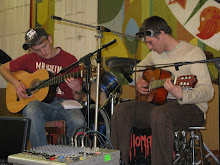
The final performance of the night was what my counterpart dubbed “The American Boys,” Curtis Schwieterman and I. We put our years of guitar playing to use and Curtis brought down the house with his smooth and forceful voice. We played Better Together by Jack Johnson, Wish You Were Here by Pink Floyd, Curtis’ own song Walking in Circles, Redemption Song and No Woman No Cry by Bob Marley, and Northbound 35 by Jeffrey Foucault. One of the best parts during our performance was when I asked in Russian, “Do you know Bob Marley?” and the audience roared. Ukrainians LOVE clapping along and they tried do likewise during our songs, which didn’t really mesh since some of our songs were very mellow and solemn, so it turned into a funny cross cultural moment. We received a more than warm reception and it was truly an amazing opportunity my school was never hesitant in providing. We took many photos and videos and hope to share them with you all when I can.

Ultimately, seven Americans and about 150 Ukrainians were in attendance for the night’s two hour concert. I was proud to see sixth graders to teachers and school alumni and of course especially happy to see my students present. It was the most exciting and personally rewarding thing I’ve done so far and I hope it had some lasting effect.

Sunday, March 22, 2009

An opportunity to help volunteers in Ukraine

The following introduction and article was written by PCV Amber Webb who shared a training site near Kyiv with me and currently lives in my neighboring oblast. She's spearheading a project with PC Ukraine's Environmental working group, which I take part in, and together we will implement this project if we receive the required funding. Enjoy. Keith
________


Hello Friends and Family of Keith! For the past year and a half, I've been a Peace Corps volunteer with Keith here in eastern Ukraine. I'm writing today to tell you about an exciting project you can get involved with! I'm sure Keith has written often of the circumstances we live in, yet wonderful people we have the brilliant opportunity to work with! As a member of the Environmental Working Group, our current project is to increase environmental awareness across Ukraine. The Project is called 'Eco Meters Across Ukraine' and can be viewed more on the Peace Corps website. I'd really appreciate if you could take the time to read a quick article about our lives here in the East, and go onto the PC website to donate to the project if its within your means. Thanks for you time! Email me with any questions or comments you may have! To donate: Go to www.peacecorps.gov, Click Donate, Click Current Volunteer Projects, wait for the entire screen to pop up and scroll to the very bottom. You'll find our project title 'Eco Meters' A.Webb KS Peace, Love, and Smiles,Amber WebbPCV Yasinavataya, Donetsk Oblast, Ukraine

___________________


Babas, Bucket Baths, and Lynch Mobs - Amber Webb

Yesterday a baba asked me why I chose to come to Ukraine. What’s a baba, you may wonder? Baba is the affectionate term for ‘grandmother’ in Russian. They are the hardened post-soviet women, draped in head scarves and thick stockings, pedaling their pickles and beets on every street corner, and absolutely the purest representation of Ukrainian culture. They’ve endured famines and wars, don’t even flinch at sub-zero temperatures, and can drink vodka like its water. Don’t you know in Ukraine, a shot a day keeps the doctor away? So when one of these stoic daughters of Lenin asks you a question, you’d better be prepared to answer.

Seventeen months ago, I arrived in Ukraine as a Peace Corps volunteer. Ukraine is not a country that you’ll often see in the media for such horrors as the kidnapping drug cartels of South America or the child soldiers and spreading AIDS epidemic in Africa, but it is a country of many problems that simmer just below the surface of the world’s attention.

My assignment is in the Donbas region of eastern Ukraine. It is the most industrialized and polluted area in Europe. I’m sure after two years in the Donbas, my daily runs will result in Black Lung and the occasional dip I take in the river will produce a second belly-button or 3-eyed offspring, but this is my life as a Peace Corps volunteer. I wake every morning hoping for running water, sometimes arrive to work dazed and slightly euphoric from the exhaust-filled buses, and have on occasion, slept in a parka and snow boots on the bitterest of winter nights. But for all its hardships, Ukraine has also given me moments of confused but well-intentioned oddity.

On a Peace Corps budget, my washing machine is actually a bucket which doubles as my bathtub. Hence, I hand-wash my clothes… and apparently not very well. One day, after returning from work, I went to collect my drying garments from the line. Under the watchful eyes of collecting babas, I took my clothes only to find that they were a little cleaner than when I’d first left. Wondering how this was possible, I looked around until the herd of babas that had secretly re-washed my clothes, tried to hide the evidence by scattering to the wind and avoiding eye contact. I didn’t pursue any accusations in hopes that the practice would continue.

On another occasion, it was yet one more evening of the frequent power-outages in my town. On the assumption that the clumsy American girl probably didn’t think to have candles, the neighborhood kids came to bring me some. When they found I wasn’t at home, worry set in. Armed with flashlights and candles, babas and parents in tow, they marched through the streets to find me. After buying a phone card from a man on the street, I glanced up to see what looked to be a lynch mob coming my way. My initial reaction was to run. I do only live a few hundred short miles from Transylvania and visions of Frankenstein and burning at the stake were running through my mind. However, in a brief and rare moment of rational thought, I realized that Ukrainians are generally a kind and giving people. They returned me home safely, stocked with candles and matches and I have since wondered why they take such care of me and have such respect for what I do?

One explanation is that many Ukrainians wonder why I would leave the comfort and affluence of the US to be a volunteer in Ukraine. For them, this is a county that was dealt a bad hand. The constant political instability and on-going corruption has only lead to a public acceptance of stagnant development. The economy is failing, public welfare is neglected, and the environment becomes more and more detrimental to health everyday. Even now in the second decade of post-soviet development, mentalities have been slow to change, activists are few and far between, and for many it is a waiting game of unlikely government support. Yet, Ukraine is a country with much potential for development. For years now they’ve teetered on the edge of success and efficiency, yet never quite crossed the finish line. My job and the job of Peace Corps volunteers worldwide is to help facilitate this process.

So why did I come to Ukraine? Why do I live in darkness 16 hours a day and survive on a diet of cabbage and potatoes? I’d like to say it’s the exotic local and easy life, but this is the Donbas. The kid I see recycling his trash, the students I see collecting clothes for orphans, and the activism of my blind friends here to make a better life for all minority and repressed groups, that’s the reason I came. The Ukrainians I work with may lack funds, but they definitely don’t lack spirit. Introducing these ideas of sustainable development and volunteerism to such people is what makes me smile, even on the darkest days here in Ukraine. It is for this reason I write. Currently, many of my students have embarked on a project to increase environmental awareness. The project is call Eco Meters Across Ukraine and the idea is to start mass clean-ups in urban areas and to paint environmental murals in the most dirty and polluted regions. Because the economic crisis is hitting worst abroad in the developing world, our ability to fundraise is limited. Hence, we write to you in hopes that you can spare a little extra money to make a difference not only to my hard-working students, but also to the thousands of Ukrainians that will see our murals on a daily basis.

If you would like to contribute to this project donations are tax-deductible. Please visit the website:

www.peacecorps.gov, click on donors and donate to a volunteer project. For region, type Europe and Central Asia. You can also type that my home state is Kansas. Submit and scroll to the bottom of the page. The project is called “Eco Meters Across Ukraine”.

HIV/AIDS Project - Pt. I

Friday, March 20th was the first activity of several up and coming events related to my HIV AIDS prevention and awareness project which was funded by PEPFAR (the President’s Emergency Action Plan for AIDS Relief).

Our school had a dance to help raise awareness about the problem of HIV/AIDS in Ukraine, Europe, and the world. It was mostly organized by my PEPFAR colleague, Inna, a teacher of biology at my school who attended a week long training seminar with me in Kyiv provided by Peace Corps.

We’ve had some disagreements and a few snags with the implementation of our project, mainly due to lack of experience executing a real project with real money and the language barrier. Most of my time is spent speaking English as my primary work is teaching English as a foreign language. Not to mention, she speaks Surzhik rather heavily, a blend of Ukrainian and Russian, so my Ukrainian vocabulary has slowly increase.

We invited all students from 8th grade and up from my school and School Number 2 where my site mate Chris works. At first I was uncertain as only a handful of students arrived by the official start time, 4:00pm. We pushed back the opening speeches and introductions by an hour and students danced and talked while others arrived. At 5:00pm we had about 30-35 students, which was less than we were both expecting. Anya, an 11th grader, gave an introduction of my project work with Inna which includes training teachers to be service providers and how to talk to kids about HIV/AIDS and then I gave a short speech in Russian.


Good evening. I would like to say that we have worse diseases than HIV and AIDS; for example, fear, hatred, ignorance, and discrimination.

HIV and AIDS are problems which are both important and serious. This is not only a problem for people citizens of Ukraine, but citizens of the world. We have a responsibility so that people who live with HIV and AIDS don’t live alone.

Ukraine has the highest HIV/AIDS infection rate in Europe. Protect yourself and those you love.

And remember that HIV is not transmitted through laughter or friendship, and certainly not through dance. Let’s dance! In Ukraine and America, it’s fashionable [smart] to be healthy.

The students starting cheering despite my inability to pronounce the word ignorance in Russian, obyazannast. The students organized the music and acted as DJs and every fourth song or so, students gave information about HIV/AIDS transmission and prevention, which was executed wonderfully.

They spoke about Freddie Mercury, the former leadsinger of Queen who died of AIDS. Queen is an exceptionally popular group in Ukraine and only last year the remaining members performed an HIV/AIDS benefit concert in Kharkiv for free in front of about 300,000 screaming Ukrainians. After speaking about the death of Mercury, they played a Queen song and every student knew every word in English and as they screamed the words at the top of their lungs I felt foolish as I didn’t even recognize the song!

I’m really proud of my counterpart and how well she planned the activity. We had about fifty students come and raised just under 40 UAH which at the current exchange rate is about 5 dollars but for Ukraine that is quite a bit. At first I was disappointed at the small turnout, but the students had so much fun and as I thanked them as they left, they said “No, thank you!” which totally sealed the event as being a success.

I never thought dancing with 14-17 year olds for three hours would be so much fun, but really it was a great time. Chris came as well as one student from his school and it was just a great, fun, positive environment.

In two weeks, we will be having a Rock Festival at school. Three of our school’s rock groups will play. My good friend Curtis will accompany me on some acoustic songs as well which makes me excited. In between groups, Inna will show segments from the Queen concert in Kharkiv which was broadcasted. It’ll show information about Mercury’s life, HIV in Ukraine, and select songs from the group. I can’t wait for this event as rock is more popular than the disco scene and more students will come as they won’t be expected to dance – or at least I hope this forecast comes true.


So signing of with our project’s slogan, It’s smart to be healthy!

Sunday, January 18, 2009

Article from my high school newspaper

Written by Hanni Reynolds

Many countries around the world are in need of assistance, and America found a way in the 1960s to give a hand. According to www.peacecorps.gov, Senator John F. Kennedy challenged students at the University of Michigan to serve their country in the cause of peace by living and working in developing countries. From that inspiration grew an agency of the federal government devoted to world peace and friendship called the Peace Corps (PC).


Keith Gough, a 2002 graduate of MHS, is currently in Ukraine volunteering for the PC.
In Kennedy’s famous inaugural speech, he stated: “Ask not what your country can do for you. Ask what you can do for your country.” Gough said that the Peace Corps is one example of how to fulfill that idea.


“I first considered Peace Corps during a course at Indiana University called Human Impact on the Environment where the instructor taught about effective agricultural practices by presenting his experiences as a Peace Corps Volunteer in South America,” Gough said.

Gough, who has been volunteering since October 2007, said that the goals of the PC are to provide countries with trained and capable workers who will pass on skills and information to help the host community grow, promote a better understanding of Americans on the part of the people served and to promote a better understanding of the people served part of Americans. “I have met amazing volunteers who have already done more with their lives than I could ever imagine. I've made lifelong friends with Ukrainians and Americans and no two days here are the same,” Gough said.

Gough was studying Social Studies education and he thought the Peace Corps would be good way to relay information about history, culture, geography and more through first hand experience. "There is only so much you can learn from a book and from a classroom and I thought about how much volunteering would help as an educator,” Gough said.

Before taking part in the PC, Gough volunteered locally. He attended Indiana University and volunteered working as a tutor for children from domestic violence backgrounds. He also worked in a crisis shelter, and was a mentor for Big Brothers, Big Sisters. “Peace Corps was a way I could take volunteering to the next step and learn skills that would continue to benefit me as a teacher and a human for the rest of my life,” Gough said.


In high school, Gough did not care much about anything. He said he wasn’t the best student and should have done more in school. “I was an average student in high school and didn’t take advantage of the opportunities available, especially at MHS,” Gough said. “So I always felt guilty that my parents paid for my schooling when I never felt like I earned a free ride.” He said the Peace Corps was a way he could earn an achievement on his own and be more independent.

It was very difficult to stray far from his family even when he liked the independence.
“Saying goodbye to my friends and family was very difficult, especially since I’ve traveled very little and my only time away from home was during college,” Gough said.

He said it was very hard for him to leave, but he received only love and support from all of those who were closet to him, including his first host family in Ukraine. The first three months of volunteer work were training. The PC training includes learning languages and jobs, health and safety, and crossing culture.

“Volunteers live in a training site during this time with other volunteers who share all the same training sessions,” Gough said.

For three months, Gough had five hours of Russian language every weekday.
“Russian is a very difficult language to learn, but living here means I have to speak it whether I’m buying train tickets or haggling in the bazaar (an open market),” Gough said. He has passion for the PC and suggests that it would be a good idea for students to consider volunteering one day. If high school students are interested in Peace Corps, he recommends reading about the programs.

“Try to find opportunities to volunteer in your community as America is greatly in need, Gough said. “Find opportunities to travel if you can or to work with those from different countries. All these things will prepare those who are interested in applying for the Peace Corps.”

Although the Peace Corps is mainly for college graduates, it is still a goal that high school students may achieve.

During his experiences overseas as a Peace Corps volunteer, he believes he has grown in so many ways. “I am no longer afraid of making mistakes,” Gough said. “If I was, then I wouldn't be able to do or accomplish anything here.”

“I've also become more aware of my own ignorance, about politics, culture, history and so forth. Americans often think things work the same everywhere in the world, and that simply isn't true.”
Gough said that the schools are so much different from America that it is hard not to think of things in terms of right and wrong simply because things differ from what I am used to.

Gough is a member of PC Ukraine’s Environmental Working Group and he just finishes writing a President’s Emergency Plan for AIDS Relief grant to fund an HIV AIDS awareness project that plans to educate thousands of adolescents about HIV prevention and transmission. “I’m trying to dispel myths and arm students and teachers with information that can save lives.” He is still in Ukraine, and will be until December 2009. He is continuing his passion and says he is loving every moment of his experiences.

“After reading the book ‘Three Cups of Tea’, the biggest thing I took away from volunteering overseas is not exactly what you do, but how,” Gough said. “Tasks cannot be on an American timeframe or completed in the same way as in the States, and it is very important to work with your community in a familiar way to make them comfortable. These are all things I would not have been able to perceive before being a PCV.”

Friday, May 23, 2008

Gender Studies in Ukraine

Peace Corps Ukraine has many working groups, one of which is Gender and Development (GAD) which works to change unhealthy perceptions and stereotypes about gender roles through summer camps, lesson plans, contests, and many other activities.

I passed on the information for the 2008 essay contest to my counterpart and she promptly worked to make the composition an in class control work assignment that would count as a grade but also later be entered into the contest via email. Unfortunately, this did not go completely as planned as there were supposed to be in class discussions and readings about the issue of gender prior to the assignment but I did not conduct these classes, and to be honest I’m not sure if I would have found appropriate materials in time. Also many students simply found articles online and copied and pasted them into Word Documents then used translator programs on their computers to translate into English. In the end, we sent away about eight or nine essays to the contest, though they weren’t really close to the five hundred word stipulation and I’m sure the students had plenty of help from teachers or siblings, but at least they are working and thinking about such issues. My favorite essays were the ones with the most mistakes as I know the students wrote the compositions themselves.

This year’s topic was: World Life Expectancy Fact Sheet

“The life expectancy in Ukraine is lower for men than it is for women. Currently the corresponding decline in life expectancy is 4.5 years for men and .3 years for women (World Health Organization, 2003).
The average life expectancy of men in Ukraine is 62 (World Factbook).
The average life expectancy of women in Ukraine is 73 (World Factbook).

Country yr. 2000 Life Expectancy yr. 1998 Life Expectancy
Canda 79.4 79.2
Iraq 66.5 66.6
Mexico 71.5 71.6
Romania 69.9 70.5
Ukraine 66.0 65.8
U.K. 77.7 77.2
United States 77.1 76.1


The assignment asked the students to explain what they believe the causes of the decrease in life expectancy as well as the discrepancy between male and female life spans and what they would do if they were President to fix the problems. Most of the responses I’ve read have dealt with alcohol which is no mere coincidence, but rather it seems like a cry for help. Sadly, this essay contest came only two weeks after the death of the Physical Education teacher’s son who worked in Kyiv and was barely forty years old died of a heart attack. I also met a man whose brother died during a simple dental procedure and I realize the status of health care here is no laughing matter.

Some Americans may think Ukraine’s cheap price of liquor, no open container policy, and ability to drink not only on the streets but on public transportation to be good things, but these are all things that are having very serious impacts on this country and population.

Here are some of the essays written in English, others were in Ukrainian, I sent to be submitted. Mind you some of the wording is unclear but I felt it important not to change what they wrote.

________________________________________________________________________

Dmytro Hundar
Grade 6
Belovodska Gymnasium

My name is Dmytro Hundar. I live in Ukraine. Ukraine is a big and beautiful country. It is situated in the center of Europe. Its population is forty six million, but some years ago there were much more people on our country. They say people die like flies.
I live in a small town. I know many people in my town and I can say many of them die at an early age, especially men.
When I listen to the news on TV I hear that something happens almost every day. It may be an accident on some enterprise or pit. Very often I hear about traffic accidents. People, especially young men, drink alcohol and spirits and drive their cars. I think it’s the main reason of such kind of accidents. We have very serious ecological problems in our country also.
Medical care in our country is not up to standard. We have a high sickness rate.
If I were a president I would pay much more attention to the environment protection and medical service, I would prohibit drinking of alcohol spirits and improve control on the roads.
I think all these measures will improve the situation in Ukraine.

_________________________________________________________________________

Alex Vladitchak
Age: 17

The demographic problem is one of global problems of all mankind. In Ukraine it has the specificity.
For the last ten years the population in our country was reduced almost by 4 million people. Besides there are low parameters of average life expectancy: for women this parameter is 73 years, for men 62 years. As we see, a difference essential enough.
According to these parameters we see one more problem. Such as, high fatality rate of a men.
On statistics, boys are born more often than girls (the difference makes approximately 5%) in the world. Really, has nature provided such problem?
What causes this problem on the territory of our state?
Without diving into centuries when primitive people lived among the wild nature, they entirely depended on it when often it was necessary to give a life of hunters for the extracted food (and they were men) we shall receive the following.
To begin, the big influence on quantity of the population (especially the male population) was rendered from constant wars Ukrainian people fought against the Mongolian nomads, and later against Turkey, Poland. Two world wars and two civil wars were on the territory of Ukraine only last century. And armies, as it is known, consist basically of men.
Secondly, men choose to themselves extreme trades, such as military men, miners, metallurgists, pilots, seamen and others. Accidents with plural fatal cases have happened in the last two months to Ukrainian men.
Thirdly, men are engaged in extreme kinds of sports more often: mountaineering, a scuba diving, mountain and water slalom and others where they are exposed to risk.
Furthermore, men more often than women get in various criminal situations and participate in criminal groupings. And it often costs lives.
Next, this abusing alcohol, smoking, and drugs considerably undermine health. And it is frequently also the cause of death.
And still men make the majority of drivers, which get in crashes more often. These and still many other reasons, including a usual boyish overindulgence in foolish activities.
Why does it occur? It is difficult to answer this question. Here a profound knowledge in the field of psychology is necessary. It is a separate greater theme for consideration, and we shall not concern it.
I cannot give the examples from private life; I still do not have sufficient experience. I refer to knowledge, from the literature and experience of adults. However, it is enough to understand scales of a considered problem.
What measures are necessary to make for its decision?
People from simple inhabitants up to presidents should solve all global problems. If I were the president I should do my best to prevent wars and to keep peace all over the Earth. I should create all conditions to develop economy and social policy to provide a high material and spiritual standard of living of people, to care about health of each person, to stop all diseases, and to give the people the possibility to get jobs they need.
And the most important - to teach each person to appreciate and protect the life as a gift.


Alina Volvak
8th Grade

I am a Ukrainian and I’m proud that my motherland is Ukraine. I’m nearly fourtneen years old now but I understand that I was born in the years when Ukraine had proclaimed its independence and I had become a small part in the history of my “mother.” When Ukraine proclaimed itself democratic, legal, and social state, it took the duties to keep the demands of international community according to equal rights of citizens, including the problem of carrying gender changes concerning sex signs.

As the United Nations Organizations considers all men and women must have equal reigghts and possibilities, they must realize their aims and dreams into life, they must respect one another as equal among them.

Nowadays the psycho-emotional behavior of women becomes more aggressive, and the behavior of men – softer. It leads to the fact that fatality rate of men at an early age increases. T’s sad but Ukraine takes the first place in the world concerning fatality of men from twenty to forty five years old. We must immediately do something with this problem. The situation in the country shows that the number of population decreases, the state of health of men becomes worse. According to the facts women live ten to twelve years longer than men. It’s connected with the fact that our government, our society pay not enough attention to the men’s healthy. They feel problems keenly, for example in the sphere of economy if their salary is very low.
We have many ecological problems which influence our health greatly, for example the accident at the Chornobyl power Station (the Chornoboyl Tragedy), the epidemic of AIDS, the tuberculosis, and other infections. They lead to the premature deaths, disablements, and other diseases. I think that the usage of alcoholic drinks, drugs, and other harmful things influence negatively on men. Looking for a way out of a complicated situation a man resorts to physical violence, to a risky way of life, to criminal crimes. I have a friend who is brought up only by a mother. He doesn’t feel the care and presence of a father in his life. But it is not correct being. Having left with the child neither mother nor father are bale to make valuable conditions for child’s upbringing. From his childhood a child has such psychological changes which can lead to mental disorder.
If I were a president, I would provide all people with regular jobs, with dwellings – to make sure in tomorrow’s day. In order a green dragon not to ruin our families. I would solve this problem on the state grade because nowadays this one is a tragedy nearly in every family. For this purpose it is necessary to institute control over the production and trade of alcohol.
It’s necessary to keep in mind that when a boy or a girl is born they both possess equal rights as citizens of Ukraine in future any of their rights mustn’t be infringed on. I would like every person to realize himself in any sphere of life and nobody and nothing would become an obstacle for this!
I believe you and trust you, my dear Ukraine!


Yulia Grozdikovoi
8th Grade

Once my classmate said to me: “There are not enogh men in the world. You must take care of us”.
People never think about the statistics of death in Ukraine, but it’s very important. The lives of women are longer than the men’s lives. In Ukraine they live 62 years, and women live 73 years.
Today, the causes of death are very different. They are accident, illnesses, etc. But I think that harmful habits do the greatest hurt for our health. It depends on tobacco and alcohol.
Today, schoolboys and schoolgirls have these habits too. It’s very sad, because our country can’t do anything. Of course, our country tries to do something, but we can’t see this work.
Often we set the questions about our future profession. Probably, I want to be the president, but not for very long, only in order to change this bad situation.
We must introduce a few rules for that. First of all, we must prohibit selling alcohol to children. We have already introduced this rule, but only one shop in a thousand executes it. Then we must supply uncorruptible agents, who will tell us about the bad shops in all cities and villages.
Also we must imitate European countries which don’t allow people to drink alcohol and to smoke in “the streets”. They have special places for such activities.
I think that these rules are simple. And if we will do it, our men will live longer, and Ukraine will not have this problem.